Govt. seeking another US$37M IDB loan
Govt. seeking another US$37M IDB loan
…funds will be used to address learning challenges in Hinterland
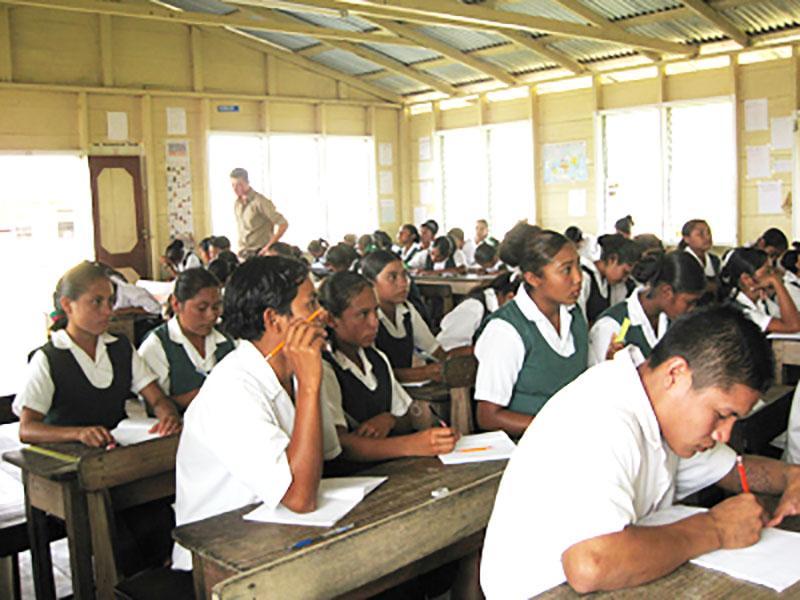
Kaieteur News- The Inter-American Development Bank (IDB) is currently preparing a US$37 million loan to support education recovery and transformation with specific programmes geared at improving learning in the Hinterland Regions.
According to the project document seen by this publication on Sunday, the loan encompasses three components. The first component will target ‘Accelerated Learning, Skill Development, and Support for Students at Risk’ while the second aspect of the loan will aid in digital transformation which will allow for laptops, tablets and other electronic devices to be purchased for students and teachers. The third component of the loan will cater to ‘infrastructural improvements’ for schools.
In justifying the loan, the IDB explained that student outcomes are low and unequal in Hinterland areas as 2019 data showed only 48 percent of students in riverine areas and only 36 percent in the hinterlands achieved the Ministry of Education (MOE) standards- defined as achievement of at least 30 out of 60 points- in English, compared with 61 percent of 6th-graders in the coastal areas.
When it comes to Secondary education, the Bank said that MOE 2017 data shows that while there is a high completion rate for primary education of 93 percent, children in the Hinterland regions (One, Two, Eight, and 10) have the highest out-of-school rate with 2.8%, 3.6%, 5.8%, and 2.9% respectively. At the secondary level, the net enrolment falls to 61%, which is low compared to LAC’s average of 74.5%.
Moreover, the lending institution stated that students in rural areas are in need of improved access to educational resources. For instance, it was explained that while on average only 48% of schools receive textbooks and workbooks on time; this percentage drops to 30% for Hinterland schools, and pedagogical materials for bilingual intercultural education are limited.
Additionally, the IDB said a 2018 infrastructure survey of 450 primary schools found that 33% need general repair; 53% require an upgrade or replacement of their sanitation and water systems; and 44% need a source of power. Meanwhile when it comes to connectivity, 195 schools (43%) have internet connectivity but insufficient bandwidth limiting the use of technology in classrooms, and 200 schools have no connectivity. The Bank also said existing schools need retrofitting to become more climate change resilient and sustainable.

Education Minister, Priya Manickchand
The objective of the first sub-component of the project is to ensure that students complete their studies. It will finance (i) the development of an “early warning system” for the identification of students at risk of falling behind and needing additional support services; (ii) provision of quality educational materials to students and teachers and others.
The second component is aimed at strengthening the integration of education technology (including both low-tech and high-tech) into the teaching-learning process. The component will finance: (i) expansion of connectivity in a first group of primary schools; (ii) provision of laptops, tablets, and other digital resources for teachers, students, and schools, including software; and (iii) digital skills training for teachers, school principals, and administrators.
Meanwhile, component three is geared towards ensuring a positive learning environment in primary schools, incorporating climate sustainability and resilience criteria (promoting energy and water efficiency, the usage of building materials with low embodied energy, and retrofitting infrastructure to be climate-resilient). To this end, financing will go to (i) an audit of water and energy availability and usage in schools; (ii) the installation and upgrading of potable water systems and power sources following energy and water.
The Ministry of Education has approached the IDB for a number of other loans this year to support the sector. While some have already been approved, the Ministry is still awaiting the blessings of the Bank to access funding for others.


