
US officials worry taxpayers will be left to foot cost to restore ocean floor
US officials worry taxpayers will be left to foot cost to restore ocean floor
– As Exxon, Shell walk away from California wells
Kaieteur News – American oil giant, ExxonMobil Corporation and British oil giant Shell are selling their California wells and officials are worry that the reason behind their departures is the looming liability for environmental cleanup – which can be left on taxpayers to foot the bill.
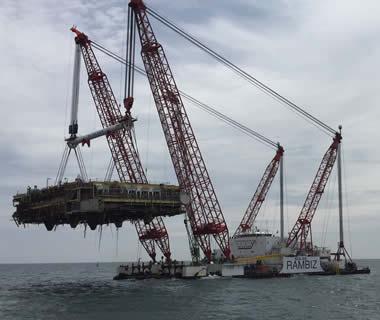 Decommissioning is the process of ending offshore oil and gas operations at an offshore platform and returning the ocean and seafloor to its pre-lease condition.
ProPublica, a non-profit newsroom that investigates abuses of power particularly in the oil and gas industry – reported that despite the price of oil produced in California this year reached its highest level in a decade, – Exxon and Shell who have done business in the State for more than a century, are selling assets and beginning to pull out of California.
ProPublica also reported that the oil giants agreed to sell more than 23,000 wells in California, which they owned through a joint venture called Aera Energy, to German asset management group, IKAV, for an estimated US$4 billion.
While Exxon and Shell say the deal will strengthen their businesses – Greg Rogers, an Attorney and Accountant who researches the oil and gas industry, said the deal allows the sellers to shed decommissioning costs. “You got bad assets with big liabilities, and you can get rid of both at the same time. That’s a win for Exxon and Shell,” he said.
Other industry experts, lawmakers and environmentalists are concerned about the deals, noting that the sales shift environmental liability from corporate powerhouses to less-capitalized firms, increasing the risk that aging wells will be left orphaned, unplugged and leaking oil, brine and climate-warming methane. They see a threat that the State’s oil industry could repeat a pattern seen in other extractive industries like coal mining and lead to taxpayers bearing cleanup costs.
California Assembly Member, Steve Bennett, a Democrat who has long worked on oil policy, has seen oil companies in his Ventura district walk away from environmental liability. “It gets passed on to a smaller company and to a smaller company until someone declares bankruptcy and the public is stuck with the cleanup bill,” he said.
According to ProPublica, if it’s not profitable to return wells to production, they need to be plugged. But if a company does not plug its wells before walking away, wells are orphaned and the cleanup costs ultimately fall to taxpayers and current operators through fees.
It was stated that in order to minimize the Government’s exposure if wells are orphaned, producers must put up a bond, typically held as cash or a surety policy. The bonds act like a security deposit in which the company gets its bond back if it cleans up its mess, but the Government keeps the money if the company orphans its wells.
Exxon’s affiliate, Esso Exploration and Production Guyana Limited (EEPGL) has been taking out money from Guyana’s oil production for decommissioning – this money is being controlled by the company.
While California has the authority to ask for an additional US$30 million in financial security from a single operator – Shell and Exxon’s joint venture holds a US$3 million bond. As a result, Aera’s bonds cover way less than what would be required to plug the wells.
According to ProPublica, California is unique because State law allows regulators to call on former operators such as Shell and ExxonMobil to help pay for plugging onshore oil wells if they are later orphaned, even by a different owner. But companies have escaped responsibility under this stronger legal standard, by exploiting loopholes such as a porous bankruptcy code.
Some experts question whether Shell and ExxonMobil would be required to pay if the wells they are selling to IKAV are ultimately orphaned, saying their ownership of the wells through a separate company, Aera, might shield them from liability.
On the local front, Exxon’s affiliate, EEPGL is the operator of Guyana’s lucrative Stabroek Block which has over 11 billion proven barrels of oil. Under a signed deal – the Production Sharing Agreement (PSA) – the oil giant has been taking out money from day one (2019) of production to set aside as a decommissioning fee.
Based on its 2021 financial statements, for 2020 and 2021, ExxonMobil and its partners, Hess Corporation and CNOOC Group, have recovered a whopping US$355.7 million for decommissioning costs which would be incurred in another 18 years for the Liza Phase One Project.
During an engagement with media operatives in June, ExxonMobil Guyana acknowledged that decommissioning funds are not needed until 20 to 30 years down the line. Be that as it may, the company noted that the provisions of the 2016 Stabroek Block deal allow for early recovery.
The oil giant assured nonetheless that when Guyana needs that money for clean-up, the money will be handed over.


