New MRCC to receive distress signals directly by next week, sub-centres planned along coast – COI hears – INews Guyana
Guyana’s new Maritime Rescue Coordination Centre (MRCC) is expected to be formally commissioned by the end of next week.
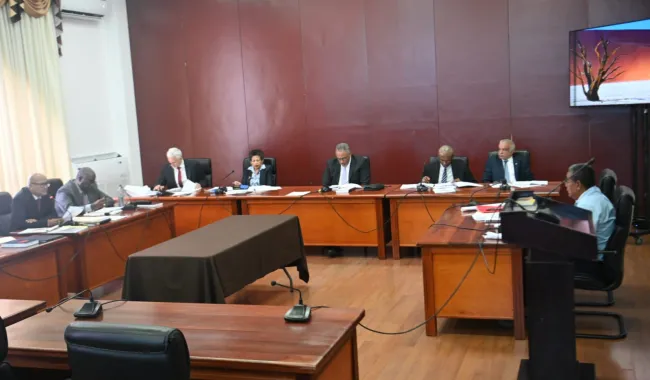
Captain John Flores, Emergency Operations Coordinator at the Maritime Administration Department (MARAD), told the Presidential Commission of Inquiry (COI) into the MV Barima tragedy on Thursday that when operational, the new MRCC will be equipped with a state-of-the-art communication system that will enable it to receive distress signals directly from US satellites.
When asked by the commission what triggered the decision to invest in a new MRCC, Captain Flores said it was a decision taken after the 2018 International Maritime Organisation (IMO) audit of Guyana.
Distress alerts from the US Mission Control Centre in Maryland, USA, are currently received by the air traffic control tower at the Cheddi Jagan International Airport (CJIA) at Timehri. The distress alerts are then relayed to the Coast Guard, Air Corps and MARAD’s emergency team.
Once the MRCC is commissioned, he said that relay will no longer be necessary.
“We will be receiving signals directly from the satellite by the end of next week. So, there’s no need for them to transmit after next week,” he said.
Once the MRCC is up and running, the Lighthouse will return to its main role of working with pilot vessels in and out of the harbour.
Captain Flores also told commissioners that the government plans to establish sub-MRCCs along the coast to provide full coastal coverage. He said the new systems, including satellite, long-range and medium-frequency radio, would raise communication effectiveness along the coast to about 90 per cent.
“So, you will always have coverage,” he said.
Familiarisation training and the formal handover to MARAD are the remaining steps, and staff already have Global Maritime Distress and Safety System (GMDSS) training.
According to Captain Flores, the contract began in March 2025. A company in France built the technical components to the International Aeronautical and Maritime Search and Rescue Manual (IAMSAR) and IMO standards.
The shortwave radios and other equipment have already been installed, with familiarisation training and the formal handover as the remaining steps.
The team already works from the MRCC building with three personnel staff around the clock, and others can be called in as required. [DPI]
Related
Discover more from INews Guyana
Subscribe to get the latest posts sent to your email.