World Court releases orders Guyana seeks to block Venezuela’s preparations, campaigning, elections in Essequibo
Last Updated on Friday, 7 March 2025, 23:38 by Writer
The International Court of Justice in The Hague, Netherlands.
The International Court of Justice (ICJ) on Friday released details of Guyana’s request for a court order to prevent neighbouring Venezuela from holding gubernatorial or legislative council elections in this country’s Essequibo Region.
Ahead of those elections slated for May 25, 2025, Guyana also asked the Hague-based ICJ, the United Nations principal court, to indicate the several provisional measures that are akin to temporary orders pending a decision; in this instance the validity of the 1899 Arbitral Tribunal Land Boundary with Venezuela.
Those provisional measures that Guyana seeks are:
1) Venezuela shall not conduct any election in, or in respect of, any part of the territory on Guyana’s side of the boundary line as established by the 1899 Arbitral Award, including by doing any of the following acts:
a) purporting to extend the right to vote in any Venezuelan elections to any individuals living within that territory;
b) distributing ballot papers, poll cards, electoral materials or any other physical or electronic electoral documents to individuals within that territory;
c) presenting or naming or otherwise supporting candidates for any Venezuelan elections within that territory;
d) establishing polling stations, counting stations or electoral offices within that territory;
e) purporting to establish, elect or appoint any office of governor, legislative council, deputies or any other legislative or governmental official in respect of any part of that territory; and
f) communicating directly or indirectly with any residents in that territory in regard to any elections planned by Venezuela.
2) Venezuela shall refrain from taking any action which purports to annex de jure or de facto any territory on Guyana’s side of the boundary line established by the 1899 Arbitral Award, including by incorporating ‘Guayana Esequiba’ as part of Venezuela.
3) Venezuela shall refrain from taking any action which would seek to modify the situation that currently prevails in the territory in dispute, whereby Guyana administers and exercises control over that area.”
Venezuela had ignored previous ICJ provisional orders in December 2023 and went ahead with a widely questionable referendum in which authorities claimed that the majority of voters said “yes” for the inclusion of Guyana’s Essequibo Region on its map and for its inclusion.
The country last year passed legislation in keeping with the purported outcome of the referendum to declare Essequibo its State and its capital, the city of Tumeremo, in Bolívar, “until a practical and mutually acceptable solution to the territorial controversy is reached with the Cooperative Republic of Guyana.”
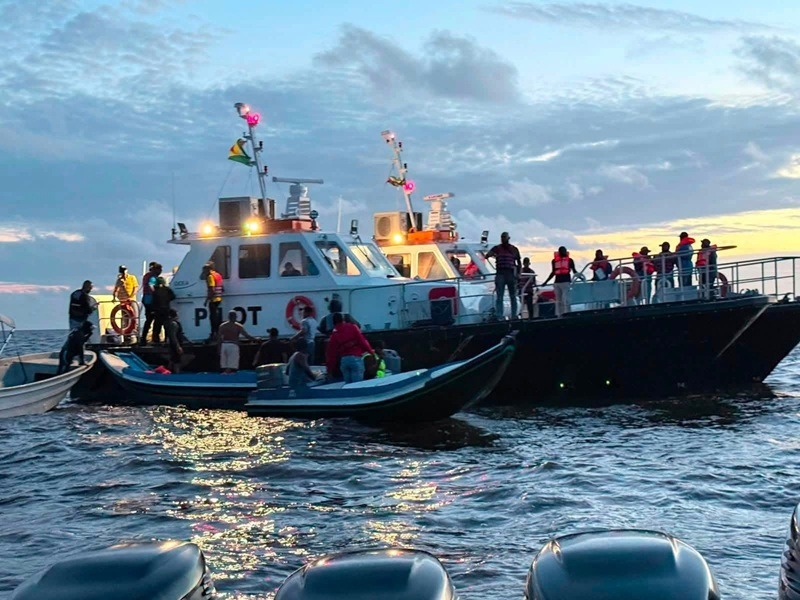
Venezuela has become increasingly aggressive towards Guyana ever since ExxonMobil announced its first discovery of oil in the offshore Stabroek Block. Its most recent act, which has been condemned internationally, is the entry of a military patrol vessel in Guyana’s exclusive economic zone that communicated with oil production and drilling vessels telling them that they were illegally in Venezuelan waters that are disputed and yet to be delimited with Guyana.
After spending 50 years of United Nations-led mediation to find a solution to the border controversy, Guyana in 2018 filed a case at the ICJ to determine the validity of the 1899 Land Boundary Award.
Although Venezuela has categorically rejected the ICJ’s jurisdiction to settle the dispute, Venezuela has been erroneously interpreting the 1966 Geneva Agreement to mean that settlement can only be done in bilateral negotiations.
Essequibo is under Guyana’s jurisdiction and is included in all internationally recognised maps of this former British colony.